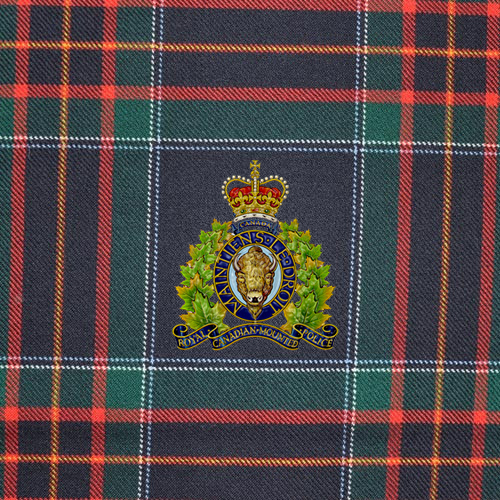
About the RCMP Tartan
The design of the tartan was undertaken to mark the 125th anniversary of the RCMP in 1997. A committee of volunteers comprising representatives of all geographical regions was consulted extensively throughout Canada. A national friendly competition was hosted to select an appropriate tartan . Mrs. Violet Holmes of Burnaby, British Columbia, provided the artwork that led to the creation of the tartan. The committee then joined with Burnett’s and Struth Scottish Regalia Ltd. of Barrie, Ontario and Lochcarron of Scotland wool mills to produce the tartan. Following approval by Commissioner Murray, the tartan was officially registered with the Scottish Tartans Society in Pitlochry, Scotland, and was formally presented to the Force by Her Royal Highness Princess Anne during her visit to Atlantic Canada in June 1998.
The tartan colours are as rich and varied as the heritage they represent. They are true to RCMP tradition as they are derived from the colours of the Force’s uniform and badge. The colours weave into a perfectly balanced tartan design. The overall effect is pleasingly subtle, reflecting a harmonious interplay of colour that provides an excellent complement to the Force’s world-renowned Red Serge tunic.
The Colours:
Dark Blue
The background or theme colour of the tartan is dark blue. It is the colour of the riding breeches traditionally worn by Mounties and is also characteristic of the shabrack or saddle blanket used by the Musical Ride. The dark hue of this blue lends a subtle character to the tartan and assures that it complements the Red Serge tunic.
Scarlet Red
Scarlet is the colour of the tunic for which the RCMP is known the world over. The rich red recalls the early years of the Force and Canada when scarlet was worn.
Yellow
Yellow represents the cavalry stripe of the RCMP’s distinctive ceremonial uniform. It also adorns the regular working dress, on both the hatband and trousers, of the dedicated men and women who serve in the force daily. This yellow is also taken from both the crown and gilt letters of the force's badge. It is, in many ways, as distinctive to the RCMP uniform as the scarlet tunic itself.
Sienna Brown
Sienna Brown is taken from the bison which is the centre-piece of the RCMP badge. It is symbolic of Canada's expansive western plains and the heartland of the RCMP.
Forest Green
Green is the colour of the maple leaves which surround the scroll and bison on the RCMP badge. The Maple Leaf, itself, is distinctively Canadian. It symbolizes Canada as a nation. The dark green of the tartan is a link to the land, the country, and the people served by the Force from coast-to-coast.
White
The fine white accent of the tartan is representative of the lanyard worn as an accoutrement to the RCMP’s ceremonial uniform. White is also intended as a link to Canada’s First Nations people. It has special spiritual significance, symbolizing strength and endurance—traits which are the legacy of the RCMP in Canada.
Sky Blue
The bison on the RCMP's badge is set into a background of sky blue. This same hue of blue is readily associated with the United Nations and has special significance to the Force, given its new-found role in international peacekeeping.